Affiliate disclosure: Tech Noun earns a commission on purchases made through the links in this article. It never changes what we recommend. Prices were checked on 20 November 2026.
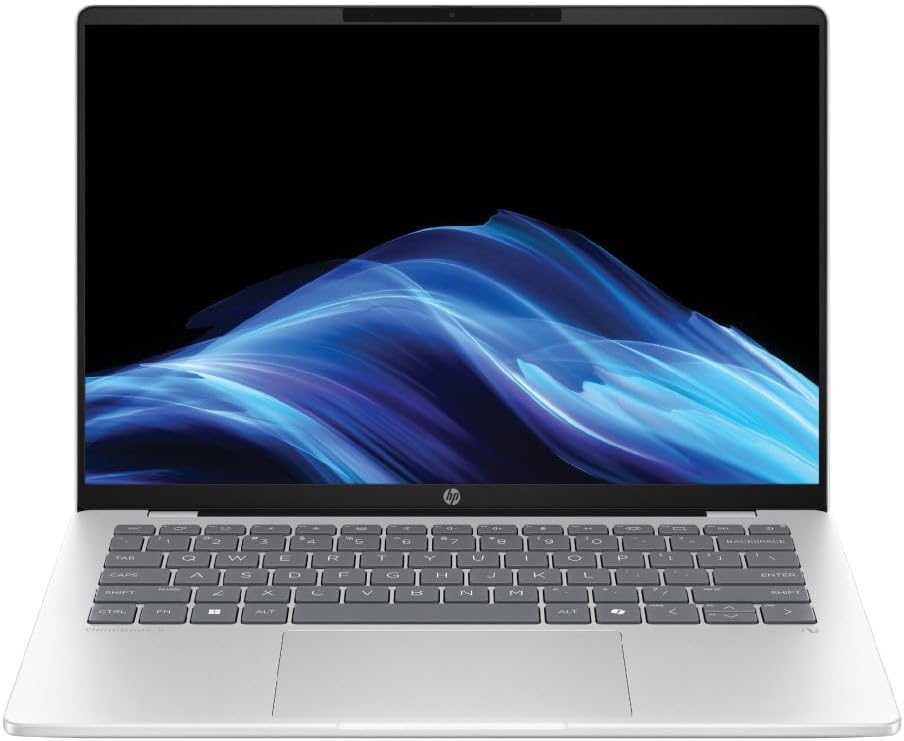
These two laptops are trying to do the same job and arriving at it from opposite directions. The MacBook Air is Apple's cheapest serious computer. The HP OmniBook 5 is a Windows machine built around a phone-style chip that was designed for battery life rather than benchmarks.
Both are quiet, both are light, and both will last a working day. The £400 gap is about something more fundamental than specification.
The short answer
Buy the MacBook Air if you can spend £1,149, want macOS, and keep a laptop for four or five years. Buy the OmniBook 5 if you need Windows, want to spend £750, and can confirm that the software you depend on runs on Arm.
Price
The Air with the M5 chip, 16GB of memory and a 512GB drive is £1,149 on Amazon, against a £1,299 list price. The OmniBook 5 with Snapdragon X, 16GB and a 512GB drive is £749.99.
That is a £399 difference for the same amount of memory and storage. The Air's premium buys you the screen, the build, the resale value and the operating system. It does not buy you more storage, and it does not buy you a faster machine for browsing.
Performance
The M5 is the faster chip by a distance, and the gap shows when you ask either machine to do something sustained: export a video, compile a project, run a large spreadsheet recalculation. The Air does it in silence because it has no fan.
The Snapdragon X in the OmniBook is not slow, and for the work most people actually do it feels identical: twenty tabs, a video call, a document, some streaming. It is only when you push both that the difference becomes visible, and by then you have usually already decided which operating system you wanted.
Battery and heat
Both are all-day machines, and this is where the OmniBook earns its keep. Qualcomm's chip is extremely efficient, and the OmniBook runs cool enough to sit on a duvet without a thought.
The Air is close and quieter under load, which sounds like a contradiction until you remember it has no fan at all. For a laptop that travels, either is fine. Neither will leave you hunting for a socket at four in the afternoon.
Software and compatibility
This is the decision, and it is not close.
The Air runs macOS, which means the full range of Mac software, excellent integration with an iPhone, and no compatibility questions at all.
The OmniBook runs Windows on Arm. Most things work: Office, Chrome, Slack, Zoom, Spotify, Teams. Some things do not: older games, a number of specialist Windows applications, and printer drivers, which remain a lottery. Adobe's creative applications run, but plugin support is patchy.
If your work depends on a specific piece of Windows software, check it before you buy, not after. This is the single most common reason people return an Arm laptop.
Ports and repairability
The Air has two Thunderbolt ports, a headphone jack and MagSafe charging. That is thin, and it means a dock if you use an external monitor and a card reader.
The OmniBook has more ports, including USB-A and HDMI, which matters if you present from meeting rooms and do not want to carry adapters.
Neither is easy to repair. Memory is soldered on both, which is why 16GB is the minimum on either machine rather than a nice-to-have.
The verdict
The MacBook Air is the better laptop. It is faster, better built, has a far better screen and will hold its value. At £1,149 it is also the cheapest way into a machine that will feel current in 2031.
The OmniBook 5 is the better buy for anyone who needs Windows and does not want to spend four figures. At £749.99 it does the same everyday job in near silence, and the £399 you save is real money.